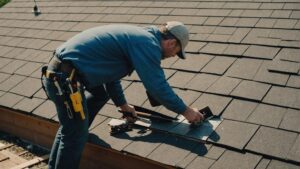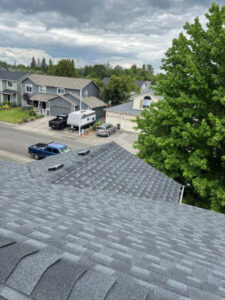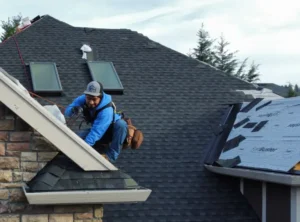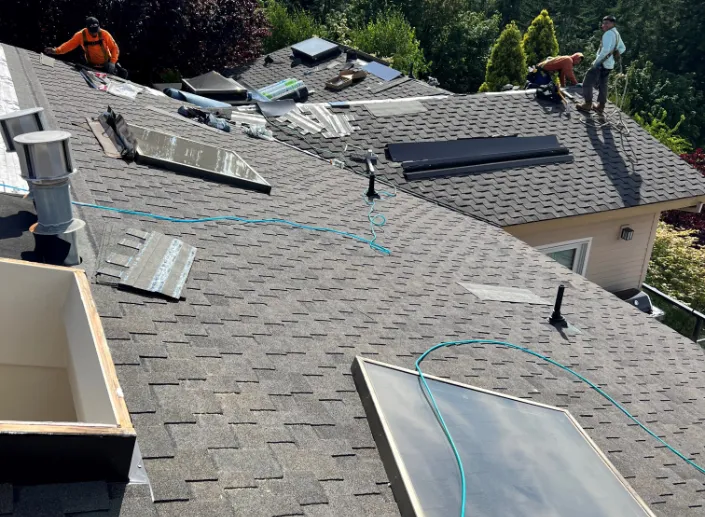
Knowing when to repair a roof and when to replace it is not always straightforward.
A missing shingle does not automatically mean you need a new roof. Neither does one leak, some moss, or simply reaching a particular age. At the same time, widespread deterioration, recurring leaks, extensive decking damage, or repeated repairs in different areas can indicate that replacement deserves serious consideration.
The best decision comes from evaluating the overall condition of the roofing system, not relying on one symptom or a generic lifespan number.
Here are some of the conditions homeowners should watch for and what they may mean.
Roof Age Is Useful Information, but It Isn’t the Whole Answer
Homeowners often hear that a roof should automatically be replaced after a certain number of years.
It is not that simple.
The useful service life of a roof can be affected by:
- Roofing material
- Specific product
- Installation quality
- Roof design
- Ventilation
- Sun exposure
- Moisture
- Tree coverage
- Maintenance
- Storm damage
- Previous repairs
- Flashing and other roofing components
Two roofs installed during the same year can be in very different condition today.
Age becomes more meaningful when it is considered together with visible deterioration, leaks, repair history, and the condition of the rest of the roofing system.
If you don’t know when your roof was installed, previous permits, invoices, real estate records, or a professional inspection may help provide additional information.
Missing Shingles Do Not Automatically Mean You Need a New Roof
Missing shingles should be addressed, but they are not by themselves proof that an entire roof needs replacement.
Asphalt shingle roofs are repairable, and isolated damaged or missing shingles can often be replaced when the surrounding roofing remains serviceable and compatible materials are available.
The bigger questions are:
- How many shingles are missing?
- Why did they come off?
- Is the damage isolated?
- What condition are the surrounding shingles in?
- Has this happened repeatedly?
- Can replacement shingles be properly integrated with the existing roof?
A few shingles damaged during a storm may call for a localized roof repair.
Large areas of missing shingles or repeated failures across an aging and deteriorated roof may point toward a broader problem.
Cracked, Curled, or Damaged Shingles Deserve Attention
Asphalt shingles can change as they age or become damaged.
Homeowners may notice:
- Cracked shingles
- Curled or distorted edges
- Torn shingles
- Creased shingles
- Missing sections
- Exposed areas of the roofing system
A small number of damaged shingles may be repairable.
When deterioration is widespread across multiple roof sections, however, replacing individual shingles may become less practical.
The condition should be evaluated as a whole rather than assuming every cracked or curled shingle means immediate replacement.
Excessive Granule Loss Can Be a Warning Sign
Asphalt shingles are surfaced with mineral granules that help protect the asphalt from weather and sunlight.
Some granule shedding can occur, particularly with newly manufactured shingles where excess granules may loosen after installation.
The situation becomes more concerning when granule loss is extensive and accompanied by other deterioration.
Watch for shingles with visibly exposed or deteriorated surfaces rather than relying solely on granules found in a gutter.
Widespread surface deterioration may indicate that the roofing material is aging and should be professionally evaluated.
Recurring Leaks Are More Concerning Than One Isolated Leak
A roof leak needs attention, but one leak does not automatically mean the entire roof has failed.
Leaks can sometimes result from localized problems involving:
- Flashing
- Plumbing penetrations
- Chimneys
- Skylights
- Valleys
- Damaged shingles
- Roof-to-wall intersections
- Other roof penetrations
When the surrounding roofing remains in serviceable condition, correcting the source may solve the problem without replacing the entire roof.
Recurring leaks are different.
If leaks continue returning after repairs or begin appearing in multiple locations, that can indicate broader deterioration or multiple failures within the roofing system.
That is when it becomes important to compare the practicality of continued repairs with a complete roof replacement.
Water Stains Should Be Investigated
Brown or yellow stains on a ceiling, damp drywall, wet attic insulation, or water marks on roof decking can indicate moisture intrusion.
However, the visible stain does not necessarily identify where the water entered.
Water can travel along:
- Roof decking
- Rafters
- Framing
- Pipes
- Other building materials
before becoming visible inside the home.
This is why simply applying roofing cement above the location of an interior stain may not correct the actual problem.
A professional inspection should attempt to identify the likely source of the moisture before determining whether repair or replacement is appropriate.
A Sagging Roof Requires Prompt Evaluation
A visibly sagging or distorted roofline deserves professional attention.
Sagging can be associated with problems involving roof decking, framing, moisture damage, structural loading, or other conditions.
It would be inaccurate to say that every sagging roof automatically needs a complete roof replacement because the underlying cause must first be determined.
However, it is not something homeowners should ignore.
If a significant section of the roof appears to be sagging, avoid walking on the affected area and have the condition evaluated by an appropriate professional.
Damaged Roof Decking Can Change the Scope of the Project
Roof decking forms the structural surface beneath the roof covering.
When accessible decking shows deterioration, soft areas, delamination, or moisture damage, the cause and extent need to be determined.
Sometimes damaged decking is localized.
In other situations, deterioration may affect a much larger area.
During a complete roof replacement, removing the existing roofing allows accessible decking to be examined before the new roofing system is installed.
J&J’s current roof replacement process includes inspecting accessible decking after tear-off and addressing documented deterioration according to the project scope.
Flashing Problems Don’t Always Require Roof Replacement
Flashing helps keep water out at roof transitions and penetrations.
Common flashing locations include:
- Chimneys
- Skylights
- Roof-to-wall intersections
- Valleys
- Plumbing penetrations
- Roof edges
Damaged or deteriorated flashing can create leaks even when the majority of the roofing material remains serviceable.
In those situations, a proper flashing repair may solve the problem without replacing the entire roof.
However, when flashing problems occur alongside widespread roofing deterioration, repeated leaks, and other failures, the condition of the complete system should be considered.
Moss Does Not Automatically Mean Your Roof Is Failing
Moss deserves attention, especially when growth becomes established on an asphalt shingle roof.
But a moss-covered roof does not automatically need replacement.
The appropriate first step may be professional roof cleaning and moss removal using a method suitable for the roofing material.
After the moss is removed, the underlying roof can be evaluated for actual damage.
Depending on what is found, the roof might need:
- Continued maintenance
- No immediate additional work
- Localized repairs
- More extensive repairs
- Replacement
The recommendation should be based on the condition of the roofing materials, not simply how green the roof looks from the street.
Multiple Previous Repairs Can Be an Important Clue
A repaired roof is not necessarily a bad roof.
Asphalt shingle roofing systems are designed so localized areas can often be repaired without disturbing the entire roof.
But repair history still matters.
If the same leak repeatedly returns or new problems continue developing in different areas, ask whether continued repair is still practical.
Consider:
- How frequently repairs are needed
- Whether leaks are appearing in multiple areas
- Whether surrounding roofing is deteriorating
- Whether compatible materials remain available
- Whether previous repairs are failing
- Whether each new problem is unrelated or part of widespread deterioration
At some point, replacement may provide a more practical solution than continuing to address one failing area after another.
Storm Damage Can Require Repair or Replacement
Wind, falling branches, hail, and other weather events can damage roofing materials.
After a significant storm, homeowners can safely inspect the roof from the ground for changes such as:
- Missing shingles
- Fallen branches
- Lifted roofing material
- Damaged flashing
- Gutter damage
- New leaks
- Roofing debris on the ground
Storm damage should be evaluated based on its extent.
One damaged area may be repairable. Damage spread across large portions of the roof may require a different approach.
For Clark County homes needing roofing evaluation, J&J provides repair and replacement services from its Vancouver location and can evaluate whether visible storm damage appears localized or more extensive.
Look Inside the Attic
An accessible attic can provide useful information about roof and moisture conditions.
Homeowners can look for:
- Water staining
- Wet insulation
- Darkened decking
- Visible deterioration
- Moisture around penetrations
- Signs of an active leak
Not every attic moisture problem is caused by an exterior roof leak.
Indoor moisture, air leakage, ventilation issues, or improperly terminated exhaust ducts can also contribute to attic moisture.
The cause should be identified before assuming roof replacement is the solution.
One Problem vs. Widespread Deterioration
One of the most useful distinctions when deciding between repair and replacement is whether the problem is localized or widespread.
Repair May Make Sense When:
- Damage is limited to one area
- Surrounding roofing remains serviceable
- The source of the problem can be identified
- Compatible materials are available
- A repair can be properly integrated into the existing roof
- There is no evidence of widespread deterioration
Replacement May Deserve Consideration When:
- Roofing deterioration is widespread
- Leaks repeatedly develop in different locations
- Large areas of roofing material are damaged
- Roof decking damage is extensive
- Repairs repeatedly fail
- Compatible repair materials are no longer available
- The existing roofing system has multiple significant problems
This distinction is more useful than simply deciding based on how old the roof is.
Don’t Replace a Roof Just Because Someone Says It’s Old
If a contractor recommends replacement primarily because of roof age, ask for more information.
A useful roofing evaluation should identify the actual conditions supporting the recommendation.
Ask:
- What deterioration did you find?
- Can you show me the affected areas?
- Are the problems localized or widespread?
- Is repair still possible?
- What is the condition of the flashing?
- Are there signs of decking deterioration?
- Have multiple areas already been repaired?
- Why does replacement make more sense than another repair?
A homeowner should understand the reason for the recommendation before committing to a major roofing project.
Don’t Assume Repair Is Always the Less Expensive Choice Long Term
Homeowners can also make the opposite mistake.
A smaller repair will generally cost less today than replacing the entire roof, but repeated repairs across a broadly deteriorated roofing system can add up.
If different sections continually develop problems, ask the contractor to explain both options.
Compare the scope and usefulness of continued repairs with the cost and benefits of replacing the existing roofing system.
The right choice depends on the actual roof, not a universal rule that repair or replacement is always preferable.
Local Conditions Can Affect Roof Condition
The environment around a house can influence how a roof ages.
Tree coverage, shade, debris accumulation, roof orientation, drainage, sun exposure, and the design of the roof can vary substantially from one property to another.
That is one reason generalized lifespan charts have limited usefulness.
For Portland property owners weighing repair against replacement, a roof surrounded by mature trees may have different maintenance and exposure conditions from an open roof only a few neighborhoods away.
The individual roof should be evaluated based on the conditions actually present.
What Should a Roof Replacement Inspection Evaluate?
Before recommending a complete replacement, a contractor may evaluate accessible areas including:
- Roofing materials
- Flashing
- Valleys
- Chimneys
- Skylights
- Roof penetrations
- Roof edges
- Drainage
- Ventilation
- Accessible roof decking
- Evidence of interior moisture
Some concealed conditions may not become visible until existing roofing materials are removed.
A contractor should explain those limitations and how unexpected damage will be handled if it is discovered during the project.
Choosing a New Roofing Material
If replacement is appropriate, homeowners can then compare roofing systems.
J&J currently installs residential GAF asphalt shingle roofing systems and also provides metal roofing services.
The appropriate roofing material depends on the particular property, including:
- Roof design
- Budget
- Appearance
- Product specifications
- Installation requirements
- Maintenance considerations
- Warranty options
- Homeowner priorities
There is no single roofing material that is automatically best for every home.
Our guide to choosing the right roofing material explains the factors worth considering before making that decision.
Questions to Ask Before Agreeing to a Roof Replacement
If a roofer recommends replacing the entire roof, ask:
- What specific conditions indicate replacement?
- Which areas are damaged?
- Can you show me photos or explain what you observed?
- Could any of the damage be repaired?
- Why is repair not the recommended solution?
- What condition is the surrounding roofing in?
- What is included in the replacement proposal?
- How will flashing be handled?
- Will ventilation be evaluated?
- What happens if damaged decking is discovered?
- Which roofing products will be installed?
- What manufacturer warranty applies?
- What workmanship coverage applies?
The answers should help you understand both what is wrong with the existing roof and what the proposed replacement is intended to correct.
So, How Do You Know When Your Roof Needs Replacement?
There isn’t one sign or one age that answers the question for every house.
Instead, look at the complete picture:
Age provides context.
Visible deterioration shows how the roofing material is changing.
Leak history can reveal whether problems are isolated or recurring.
Repair history helps determine whether continued repairs remain practical.
Decking and flashing conditions provide information about components beneath and around the visible roofing.
The extent of the damage is often what ultimately separates a repairable roof from one where replacement makes more sense.
If you notice recurring leaks, widespread shingle deterioration, storm damage, missing roofing materials, visible roofline changes, or other concerning conditions, J&J Roofing & Construction can inspect the roof and explain whether roof repair or roof replacement is appropriate based on the conditions observed.