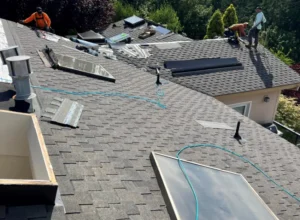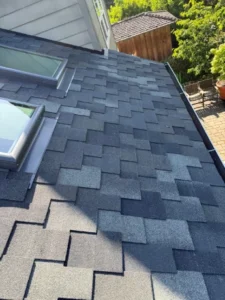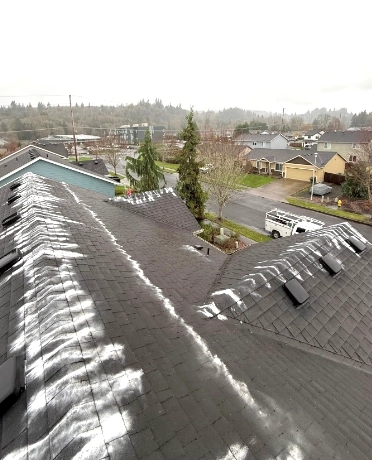
Moss on a roof is common in damp, shaded conditions, but it should not simply be ignored.
Moss absorbs and retains moisture and can grow in the spaces between asphalt shingles. As it becomes established, it can interfere with the way shingles lie and shed water. Over time, that can contribute to deterioration of the roofing surface.
If your roof has developed significant moss growth, the right approach is to remove it using a method appropriate for the roofing material and then determine whether the roof has suffered any damage.
What you should not do is attack the roof with a pressure washer or aggressively scrape the shingles.
Here is what homeowners should know about roof moss, safe removal, and preventing it from becoming a recurring problem.
Why Does Moss Grow on a Roof?
Moss grows best where moisture is available.
Roof sections that remain damp or receive limited sunlight can provide favorable conditions for moss growth. Leaves, needles, and other organic debris can also retain moisture on the roofing surface.
That is why moss growth can vary significantly from one part of the same roof to another.
You may notice heavier growth:
- On shaded roof sections
- Beneath or near trees
- In areas where debris accumulates
- In valleys
- On sections that remain damp longer after rain
A small amount of moss does not necessarily mean that the roof underneath has already failed, but established growth should be addressed before it becomes more extensive.
Is Moss Actually Bad for Asphalt Shingles?
Yes, established moss can cause problems for an asphalt shingle roof.
Moss holds moisture against the roofing surface and can grow between and around shingles. As it develops, it may lift shingle edges and interfere with normal water shedding.
Moss can also contribute to loss of the mineral granules that protect the surface of asphalt shingles.
The amount of damage depends on factors such as how long the moss has been present, how extensive the growth is, the condition of the roofing material, and how the roof has previously been maintained.
This is why removing the moss is only part of the process. Once substantial growth is present, the condition of the roofing underneath should also be evaluated.
Moss and Mold Are Not the Same Thing
It is important not to confuse roof moss with mold.
Moss is a plant that grows on surfaces where appropriate moisture and environmental conditions exist.
The presence of moss on the outside of a roof does not automatically mean mold is growing inside the roofing system or attic.
However, excessive moisture within a roof or attic can contribute to other moisture-related problems, which is why unexplained attic moisture, wet insulation, or deteriorated decking should be investigated separately.
If you have moss on the roof and also notice moisture inside the attic, the source of the interior moisture should be properly identified rather than assuming the moss is responsible.
Do Not Pressure Wash Asphalt Shingles
One of the most important things homeowners should know about moss removal is that pressure washing is not an appropriate general cleaning method for asphalt shingles.
High-pressure water can dislodge the protective mineral granules on the shingle surface and may damage or lift shingles.
That means the original advice to hire someone who uses a “high-powered jet washer” should not be followed for an asphalt shingle roof.
Roof cleaning should instead use a method appropriate for the specific roofing product and consistent with the roofing manufacturer’s recommendations.
J&J provides professional roof cleaning and moss removal for homeowners who do not want to risk damaging the roofing surface or working on a potentially slippery roof.
Don’t Aggressively Scrape Moss From the Roof
It can be tempting to take a stiff brush, shovel, scraper, or other tool to thick moss.
That can create another problem.
Aggressive mechanical removal can damage asphalt shingles, loosen granules, or lift shingle edges.
Established moss may require treatment followed by gentle removal using a method suitable for the roofing material.
The objective should be to remove the growth without damaging the roof in the process.
Be Careful With Roof-Cleaning Chemicals
Chemical roof-cleaning products should not be selected simply because they are advertised as strong moss killers.
The appropriate treatment depends on the roofing material, manufacturer recommendations, product instructions, surrounding landscaping, and the particular condition being treated.
Some cleaning solutions can damage plants and other materials if they are improperly mixed or applied.
Homeowners should avoid experimenting with combinations of household chemicals or applying products that are not intended for use on the particular roofing material.
If a professional is cleaning the roof, ask what product will be used and how it will be applied.
Why Professional Moss Removal Can Make Sense
Roof moss creates two separate concerns: cleaning the roofing material correctly and working safely at height.
Wet and moss-covered roofs can be extremely slippery. Even a relatively low-slope roof can create a serious fall hazard.
A professional roof-cleaning service can evaluate the roofing material, determine an appropriate cleaning method, and perform the work using appropriate access and safety procedures.
For homeowners considering roof maintenance in the Portland area, substantial moss growth is also an opportunity to have the visible condition of the roofing system evaluated instead of treating the project purely as cosmetic cleaning.
Cleaning can reveal damaged or deteriorated areas that were difficult to see while moss and debris covered the roof.
What Should Be Checked After Heavy Moss Is Removed?
Once substantial moss has been removed, the roofing surface should be examined for signs of deterioration.
Depending on the roof, this may include looking for:
- Damaged shingles
- Lifted shingle edges
- Excessive granule loss
- Exposed roofing material
- Deteriorated flashing
- Debris trapped in valleys
- Problems around roof penetrations
- Areas where water may not be draining correctly
Not every roof covered in moss needs repair.
If the shingles and surrounding components remain in serviceable condition, cleaning and continued maintenance may be all that is necessary.
If actual damage is discovered, localized roof repair may be appropriate depending on the condition of the surrounding roofing.
Does a Mossy Roof Need to Be Replaced?
No.
Moss on a roof by itself does not mean the roof needs replacement.
The decision should be based on the condition of the roofing materials and the complete roofing system after the moss and debris have been evaluated.
A roof may need only cleaning when:
- Roofing materials remain serviceable
- Moss has not caused substantial deterioration
- There are no active leaks
- Flashing remains functional
- Damage is not widespread
Repair may make sense when there is localized damage that can be properly corrected.
A roof replacement may deserve consideration when the roofing system has widespread deterioration, recurring leaks, extensive damaged materials, or other problems that make continued maintenance or isolated repairs impractical.
The amount of moss should not be used by itself to make that decision.
Keep Leaves and Debris Off the Roof
One of the simplest ways to reduce conditions favorable to moss is to prevent organic debris from accumulating on the roof.
Leaves, needles, twigs, and other material can hold moisture and collect in areas where water needs to drain.
Pay particular attention to:
- Roof valleys
- Areas behind chimneys
- Roof-to-wall intersections
- Areas beneath overhanging trees
- Gutters
- Downspouts
Keeping these areas clear helps water move through the roofing and drainage systems as intended.
For homes J&J serves throughout Southwest Washington, roof and gutter maintenance can be especially important on properties where surrounding vegetation deposits significant amounts of organic debris.
Keep Gutters and Downspouts Clear
Roof maintenance and gutter maintenance are closely related.
Gutters collect runoff from the roof and direct it toward downspouts. Leaves, needles, and other debris can restrict that flow.
Homeowners should periodically make sure gutters and downspouts are able to drain properly.
Problems to watch for include:
- Gutters filled with debris
- Standing water
- Sagging gutter sections
- Loose connections
- Clogged downspouts
- Water overflowing during rain
Gutter cleaning will not remove existing moss from a roof, but maintaining drainage is an important part of caring for the complete roofing system.
Consider Problematic Tree Branches
Trees can affect roof conditions in several ways.
Branches may deposit leaves and needles, provide additional shade, rub against roofing materials, or fall during storms.
That does not mean every tree near the home needs to be removed.
Instead, homeowners should pay attention to dead, damaged, or problematic branches and branches that are physically contacting the roof.
Large or hazardous branches should be handled by a qualified tree-care professional rather than treated as a DIY roofing project.
Reducing unnecessary roof contact and debris accumulation may help make ongoing maintenance more manageable.
How Often Should You Check for Moss?
There is no single inspection or cleaning schedule that is appropriate for every roof.
A heavily shaded roof surrounded by mature trees may develop moss and debris more quickly than an exposed roof that receives more sunlight.
The appropriate frequency depends on conditions around the individual property.
Homeowners can periodically look at the roof from the ground and watch for:
- New moss growth
- Increasing areas of moss
- Leaves or needles accumulating
- Missing or damaged shingles
- Debris in valleys
- Gutter problems
- Changes following storms
Catching moss while growth is still limited is generally easier than waiting until thick mats cover large portions of the roof.
Can You Prevent Moss From Ever Coming Back?
It is difficult to guarantee that moss will never return when the environmental conditions remain favorable for growth.
There are products and roof-maintenance strategies intended to inhibit future growth, but their suitability depends on the roofing material and the particular roof.
For example, zinc-strip products designed for roofing applications are available that are intended to help inhibit moss growth as rainwater moves over the zinc.
Such products do not remove existing moss, and they should be installed according to the product manufacturer’s instructions.
No preventive method should be treated as a substitute for periodically observing the condition of the roof.
What Should You Ask a Roof-Cleaning Contractor?
Before hiring someone to clean a moss-covered roof, ask:
- What cleaning method will you use?
- Will you use a pressure washer?
- What cleaning product will be applied?
- Is the method appropriate for my roofing material?
- How will surrounding plants and property be protected?
- Will the roof be checked for damage?
- What happens if damaged shingles or flashing are discovered?
- What cleanup is included?
- Are you properly licensed or registered for work in my state when required?
- Do you carry the applicable insurance for your work?
Be cautious of anyone who proposes aggressively pressure washing an asphalt shingle roof simply because it removes moss quickly.
Removing moss quickly is not useful if the process damages the shingles underneath.
Don’t Ignore a Roof Simply Because the Moss Is Gone
A clean-looking roof is not necessarily a problem-free roof.
Cleaning addresses moss and debris. It does not automatically correct:
- Damaged shingles
- Failed flashing
- Existing leaks
- Damaged roof decking
- Ventilation problems
- Drainage problems
- Previous installation defects
If substantial moss was covering the roof, cleaning provides a good opportunity to evaluate the exposed roofing materials and address actual problems that become visible.
The Right Approach Is Cleaning Without Damaging the Roof
If your roof is covered in moss, the goal should not simply be to make it look clean as quickly as possible.
The goal is to remove the moss using a method appropriate for the roofing material while preserving the shingles and identifying any damage that may already exist.
For an asphalt shingle roof:
Do not pressure wash it.
High-pressure washing can damage the shingle surface and dislodge protective granules.
Do not aggressively scrape it.
Mechanical removal should not damage or lift the shingles.
Use an appropriate treatment.
Cleaning products and methods should be suitable for the roofing material and used according to applicable instructions.
Evaluate the roof afterward.
Once moss is removed, look for damage that may require repair.
Address the conditions around the roof.
Leaves, needles, clogged drainage, shade, and problematic branches can contribute to conditions favorable for future growth.
J&J Roofing & Construction provides roof cleaning and moss removal as well as roof inspections and repairs when cleaning reveals an underlying roofing problem. The appropriate solution should be based on the condition of the roof, not simply the amount of moss visible from the ground.